The Cognitive Router

Layer 1: You Are the Packet Scheduler
I built a five-model AI pipeline before I understood that I was describing myself.
Perplexity handles research. Claude expands narrative. Gemini audits clarity. DeepSeek critiques structure. ChatGPT integrates the final pass. Each model has a defined role, a scoped input, and a clear output condition. No model gets a task it wasn't designed for. No task runs without a routing decision upstream.
I called it an orchestration system.
What I was actually building was the architecture I wished my own attention ran on.
Because here's the truth: most people's attention has no router. It has triggers.
The Routing Problem
Here is what ungoverned attention looks like in operation.
You open your laptop to do deep work. Before the first keystroke, you check email — one notification, five minutes, done. Except it wasn't done. The email introduced a low-priority concern that now occupies a background thread in your cognitive stack. You didn't decide to think about it. It got routed there by default.
You return to the deep work. Forty minutes in, a Slack message arrives. You glance at it — two seconds. You didn't spend two seconds. You initiated a context switch with an eleven-minute recovery tail. Research on cognitive task-switching puts the reorientation window at fifteen to twenty-three minutes per interruption. You didn't lose a glance. You lost the session.
By end of day, you have processed an enormous volume of inputs. Email threads, meeting notes, social feeds, news cycles, ambient notifications. Your cognitive stack ran at high utilization all day.
And the deep work — the mission-critical, compound-building, irreplaceable sessions — never got bandwidth.
This is not a discipline failure. This is a routing failure.
In the CYW stack, Layer 1 is Control — the cognitive OS that sits above Layer 0 (the biological server) and below Layer 2 (repeatable systems). It is the attention router. The decision layer that determines what gets processing power, when, and at what depth. Without it, packets arrive and route themselves. The loudest signal wins. You are still processing — you just stopped deciding what to process.
That distinction is the entire game.
Installing the Router
Layer 1 is not a productivity hack. It is a cognitive architecture decision.
Define your processing tiers.
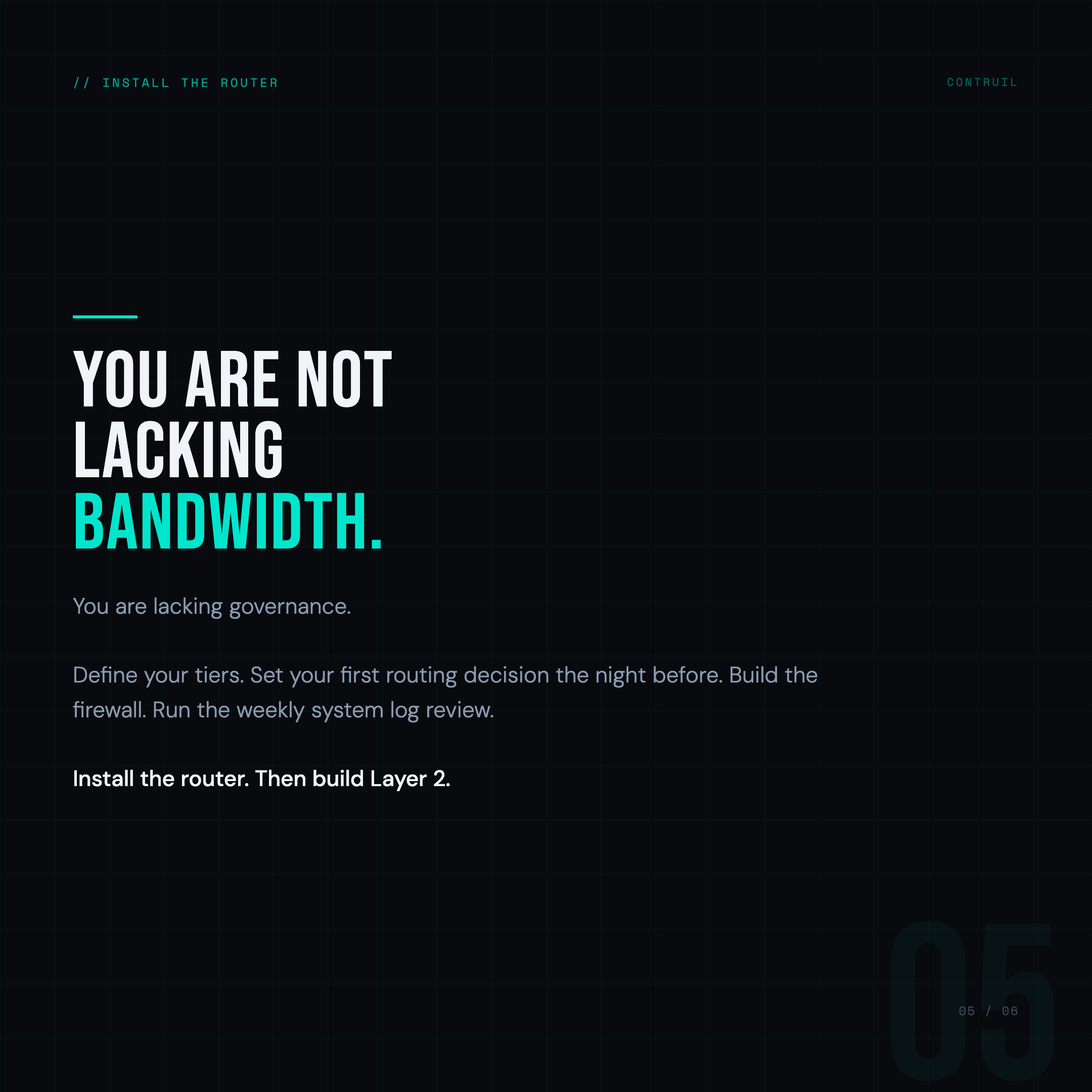
Tier
Traffic Type
Requirement
Routing Policy
Tier 1
Deep Work / Synthesis
High Bandwidth / Zero Latency
Protected Air-Gapped Blocks
Tier 2
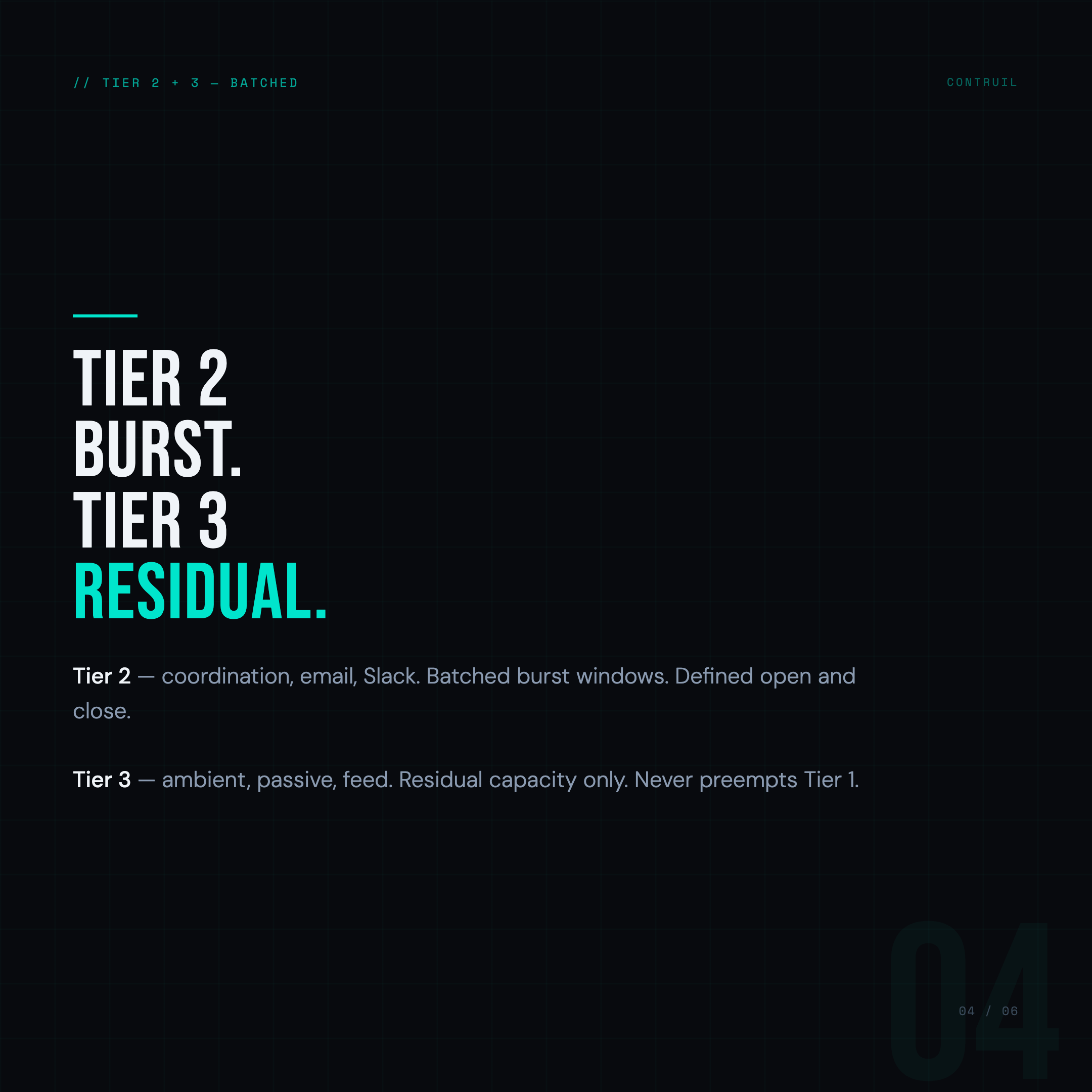
Coordination / Reactive
High Frequency / Low Depth
Batched Burst Windows
Tier 3
Ambient / Passive
Low Bandwidth / Background
Residual Capacity Only
The routing failure most people run: Tier 2 and 3 traffic preempts Tier 1 work. Deep thinking gets whatever is left over — which is usually nothing. You cannot run high-level software on a crashing OS.
Set your first routing decision the night before. The first cognitive act of the day should not be a response to someone else's input. Set it before you sleep. What is the first processing cycle tomorrow allocated to? Name it. Write it. When you wake up, that's the route. Not email. Not feed. Not whatever arrived overnight. Your designated Tier 1 work, starting before the incoming queue opens.
Once tiers are defined, enforcement becomes the system.
Build an interruption firewall. Not an absence of communication — a boundary that defines when communication gets bandwidth. Batch Tier 2 work into defined windows. Outside those windows, the channel is closed. You are not unavailable. You are processing at a different tier, and the traffic will be routed when the appropriate window opens.
Run a weekly system log review. Every unresolved concern, deferred decision, and open loop running in your cognitive background is consuming capacity you didn't allocate. Ungoverned background threads compound into cognitive debt. The weekly Layer 1 review closes the loops — not by resolving everything, but by consciously deciding what gets a processing cycle and what gets parked. Debug the week. Find the leaks. Patch the misconfiguration before it carries into the next session.
The Transmission Principle
Processing decisions propagate up the stack.
Memento Mori gave you the invariant — the session is finite, route accordingly.
Layer 0 gave you the hardware — maintain the server before you govern anything above it.
Governance of Time gave you the constitutional layer — own the routing table, or someone else will.
Layer 1 gives you the cognitive OS — install the router, define the tiers, protect the processing cycles that compound.
When I built the five-model pipeline, I made a decision that most people never make about their own attention: I decided that different tasks require different processors, and that routing determines output quality more than raw capacity does. Claude is not better than DeepSeek. DeepSeek is not better than Gemini. They are optimized for different functions. The system produces high-quality output not because any single model is exceptional — but because each model gets the task it was designed for.
Your cognitive stack works the same way. You are not lacking bandwidth. You are lacking governance.
Layer 2 is next. A router without protocols is still chaos. Systems are the repeatable protocols that run on governed attention — and once Layer 1 is operational, everything above it becomes buildable.
Control. Then Systems. Then Leverage. Then Freedom.
This is how you Control Your World.
System Log Review — Run This Before You Build Layer 2
What captured your first processing cycle of the day? The first cognitive act sets the routing precedent for everything that follows. Email means you started in someone else's queue. Social media means you started in the algorithm's queue. Deep work means you started in your own. Most people have never consciously made this routing decision. It defaulted the moment they picked up their phone.
What background threads ran without authorization? Map the cognitive processes running below conscious attention — the email concern you didn't resolve, the conversation you replayed, the decision you deferred. Each one consumed processing capacity you didn't allocate. Unauthorized background threads are the primary source of cognitive debt.
How many context switches were unplanned? Count the default interruptions — every notification checked mid-session, every tab opened out of habit, every message glanced at before the current task completed. Each is a routing failure with a recovery tail you didn't account for.
What never received a processing cycle? Name it. The work that compounds. The project that builds toward your actual mission. The thinking that requires depth and continuity. If it didn't get a dedicated, protected Tier 1 block — that is the cost of running without a router.
Timothy I. Wheels is the founder of Contruil LLC and architect of the CYW framework — a human-governed AI orchestration system that applies network infrastructure principles to attention, systems, and decision architecture. Get Rich or Get Free releases April 4, 2026. contruil.com
References: Gloria Mark, Attention Span (2023) · Cal Newport, Deep Work (2016) · CYW Framework, U.S. Provisional Patent 63/980,310 · Awareness In Action, Vol. 4